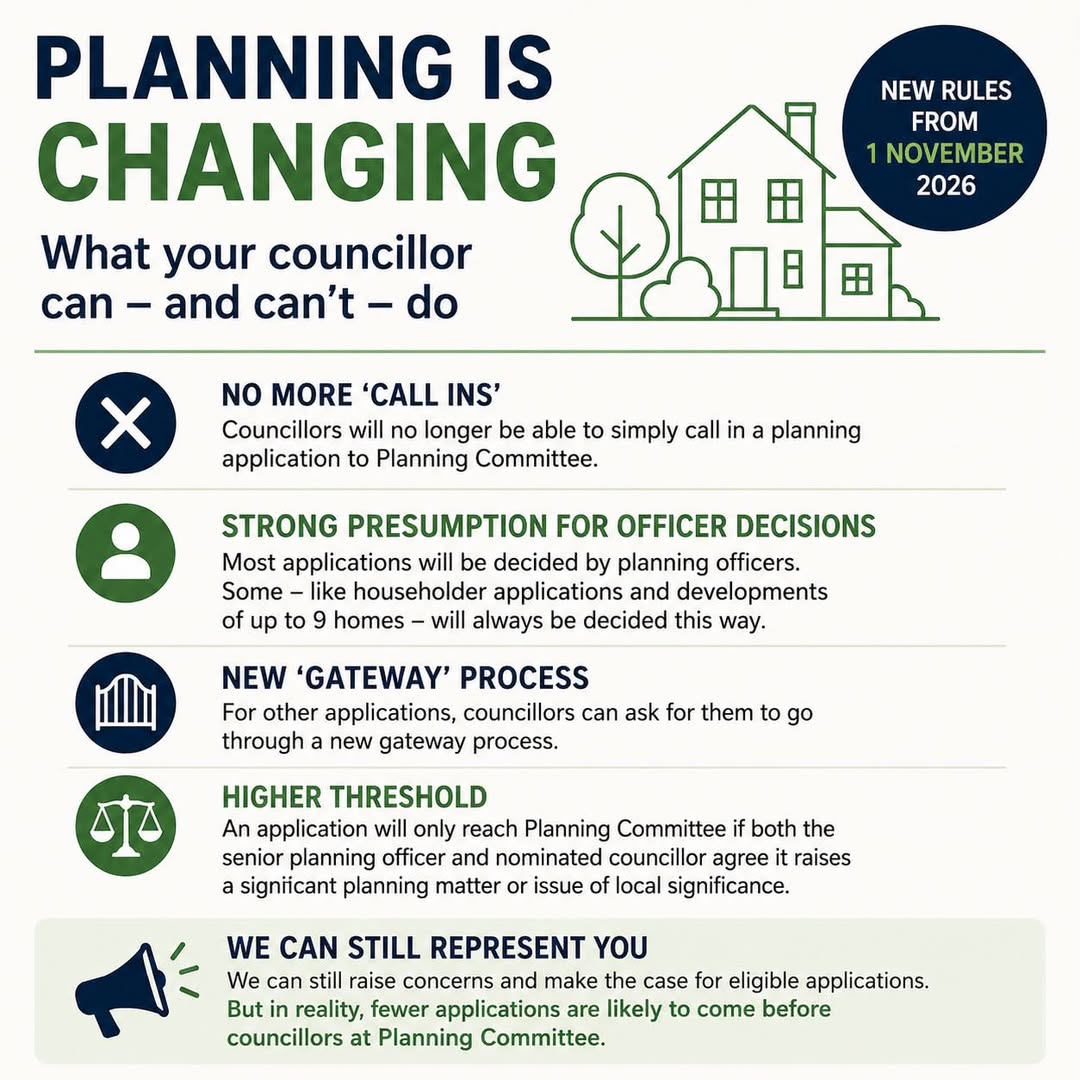
From 1 November, new national planning regulations will change how planning applications are decided – and the role of your local councillor.
The biggest change is that councillors will no longer be able to simply “call in” a planning application to Planning Committee.
There will instead be a strong presumption that applications are decided by planning officers.
Some applications, including householder applications and developments of up to 9 homes, will always be decided under delegated powers.
For other applications, ward councillors can ask for them to go through a new “gateway” process. They will only reach Planning Committee if both the nominated senior planning officer and nominated councillor agree that they raise a significant planning matter or an economic, social or environmental issue of significance locally.
So, in reality, fewer planning applications are likely to be decided by councillors at Planning Committee.
We can still represent residents, raise concerns and make the case for eligible applications to be considered, but our ability to get an application before Planning Committee will be much more limited.
I think it’s important residents know what we can and can’t do when these changes come in.